

Before You Build
Four decisions and one validation playbook before you write a line of code

You reached the start line. You are thinking to leave your job or left the job, freed up the time, committed to an idea. That’s harder than most people realize.
But standing at the start line doesn’t mean you’re ready to run.
I learned this the expensive way. Built exactly what customers asked for. Nobody used it. Out of 25 patients a physician connected me with, one responded. That user went lukewarm within weeks.
The problem wasn’t execution. I listened to feature requests instead of understanding actual problems.
This may feel like boring or not creative work for some of us but I promise you it will help you in the long run.
“It would be nice if...” is NOT “I desperately need this.”
This RFID framework (not related to radio frequency) is what I wish I had before I wasted months building.
Raise-Or-Not: Decide What Game You’re Playing
FPF: Check Your Founder-Problem Fit
ICP: Get Specific About Who You’re Building For
Distribution Before Product
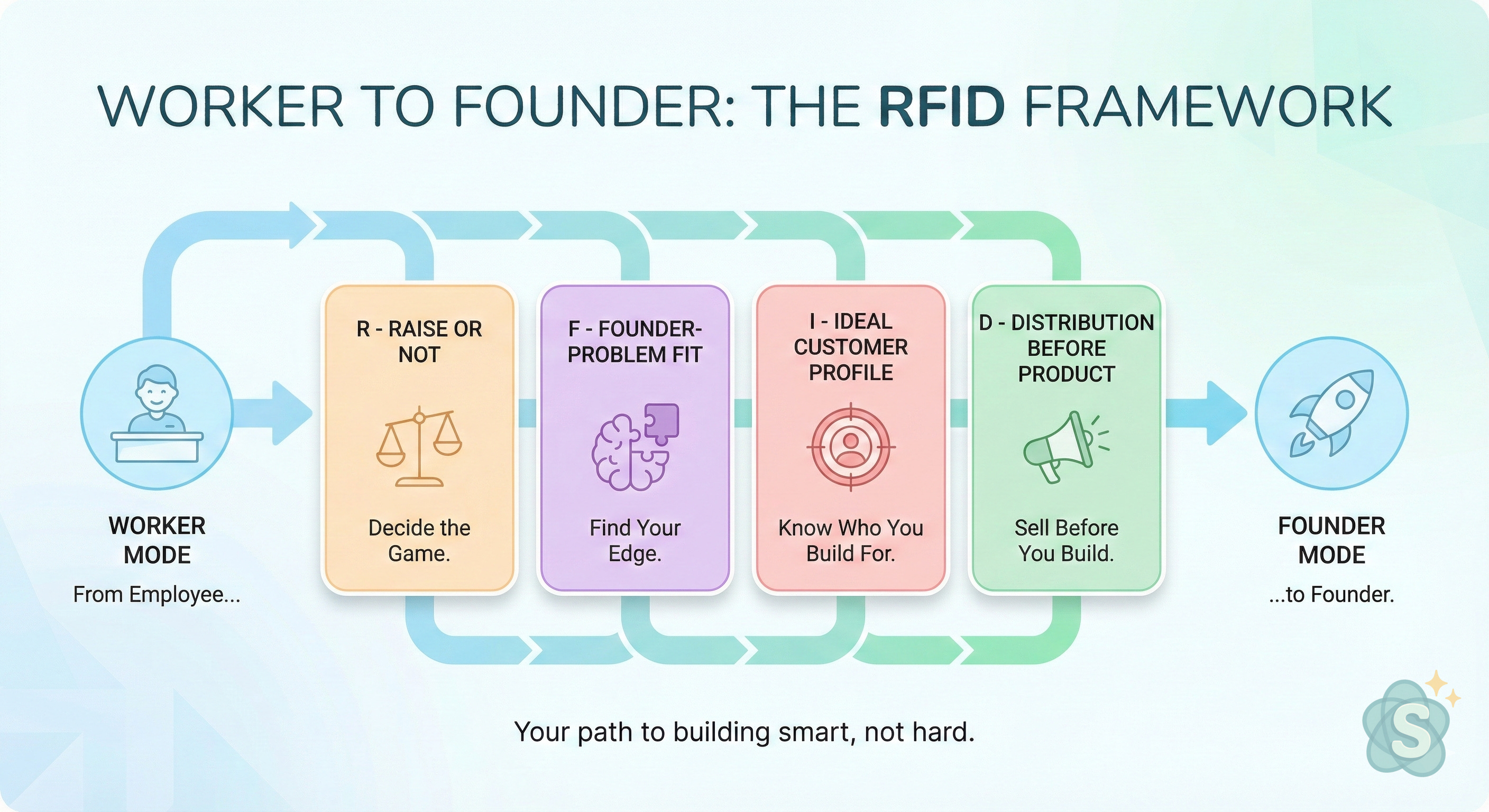
Four Decisions Before You Prototype
1. What Game Are You Playing?
Everything downstream depends on this.
Answer for yourself:
VC-backed swing-for-the-fences, or profitable small business, or side project?
Willing to go 5-10 years? How much financial risk? (Write the number.)
Non-negotiable constraint? (”Can’t quit until [X]” or “Need $[Y] by [date]”)
Control or speed? Control points to bootstrapping. Speed points to fundraising.
If you can’t answer these, you’re not ready to pick an idea.

2. Founder-Problem Fit
You will hear “no” constantly. The only thing that keeps you in the game is caring about this problem more than anyone else in the room.
Ask yourself:
If this space gets boring, would I still want to work on it?
When I talk about this problem, do I naturally go long?
Can I see myself reading books and forums about this for fun?
Is this problem personally painful to me?
If a better-paying job shows up, what keeps me here?
If your motivation is mostly “this looks like a good market,” be careful. That’s fragile when things get hard.
3. Who You’re Building For (ICP)
“Busy parents” and “knowledge workers” are not target customers. You need someone you can visualize.
Write down:
Demographics: Age, life stage, archetype. Example: “Women, 28-38, tech workers, care about skin but no time to research.”
Job-to-be-done in their words: “I want to stop wasting money on stuff that doesn’t work.”
Context where pain shows up: Sephora shelf, Amazon page, scrolling at night after kids sleep.
What they care about more than your product: Time? Money? Anxiety reduction?
If you can’t describe a day in their life, you’re not ready to build for them.
4. Distribution Before Product
You need a sketch of how people will find you before you build.
Map your ICP’s attention:
Online: Which platforms, subreddits, Discords, influencers, newsletters?
Offline: Events, meetups, clinics, conferences?
Answer: “If I wanted to talk to 100 of these people tomorrow, where would I go?”
Pick one primary and one backup channel. Don’t spread yourself across everything.
Example day-one plan (beauty/wellness ICP):
Talk to 10 people, post “3 patterns from those conversations” on IG/LinkedIn
CTA: “DM me ‘SKIN’ if this sounds like you”
DM 5 micro-creators: “Can I interview 3-5 of your followers about this?”
If your answer to “how do I get my first 100 users?” is “I’ll run ads” and you haven’t done performance marketing before, that’s not a plan.
Validate the Problem (Quick Interview Playbook)
Your job is to collect evidence that the problem is deep enough to justify your time. No pitch, no solution. Just their reality.
Who to talk to: 8-15 people in your ICP. Friends-of-friends, not close friends. Mix of people in clear pain, mild pain, and no pain.
The 30-minute structure:
0-5 min: Warm-up. “I’m not pitching anything. I want to understand what’s true for you.”
5-20 min: Past behavior deep dive. “Tell me about the last time you [problem]. What happened? Then what? What did you try?”
20-25 min: Priority and willingness to pay. “Is this top 3 for you? What would need to be true for you to pay for a solution?”
25-30 min: Permission. “Can I add you to a waitlist and share early versions?”
After each call, capture: 3-5 quotes with real emotion. Top 1-2 pains. What they already pay for. Your read: burning pain, clear pain, mild pain, or none.
Reading the Signals: Kill or Continue
After 10 interviews, synthesize.
Must-have (green): They describe the problem unprompted. Already spending money or hours on workarounds. Say “I’d pay for this if it actually worked.”
Nice-to-have (yellow): “This would be cool” but minimal current spend or effort.
No-go (red): Polite interest. Zero behavior backing it up.
My rule of thumb: If after 10-15 good interviews I don’t have at least 3-5 people clearly in “burning pain” and at least 10 who say they’d pay and join a waitlist, I pause and seriously consider killing or reframing the idea.
Your goal is not “have an MVP.” Your goal is “have enough conviction that building anything at all is the best use of the next 3-6 months of your life.”
Your First Prototype (Sharp Wedge, Not “The App”)
You’re not building “the app.” You’re building a single sharp wedge into one painful moment.
Pick one core moment. Example: “Standing on Amazon, anxious about whether this product will work for me.”
Define the smallest unit of value. “What’s the smallest thing that makes them say ‘this is actually useful’ after 1-2 uses?”
Choose form factor that lets you change your mind fastest:
Typeform plus manual analysis (painful for you, excellent for learning)
Notion/Google Doc “report”
Success metrics (behavior, not vanity):
60-70% finish the flow
50% say “useful” unprompted
30-40% want to come back or share it
Bootstrapped vs VC: How This Work Informs the Choice
If bootstrapped: Can I find a niche with painful, narrow problem that will pay quickly and I can reach without massive ad spend?
If VC/accelerator: Is the problem deep and widespread? Credible expansion path? Can I attract a team excited by the space?
Your pre-prototype work gives you conviction either way.
Questions Checklist
For yourself:
Why this problem, and why now for me?
What kind of business am I trying to build?
What’s my risk ceiling?
For the user:
“Tell me about the last time you dealt with [problem].”
“What did you do? Then what?”
“What was the most annoying part?”
“What have you tried to fix it?”
“How much time or money have you spent?”
“Is this top 3 for you?”
“Would you pay ~$[price]/month if it actually worked?”
“Can I put you on a waitlist?”
Killing weak ideas early is a superpower.
For the market:
If this works in a small niche, what’s the logical expansion?
Could this be a category, not just a feature?
Does this need VC?
If you don’t like your answers, don’t build yet.
Before You Prototype
Write down your answers to the Questions Checklist
Talk to at least 5 people in your ICP and capture real stories
If you want feedback, send me:
Your ICP in one sentence
3 quotes from interviews
Your current “first prototype idea” in 3 bullets
I’m happy to help you pressure-test it.